

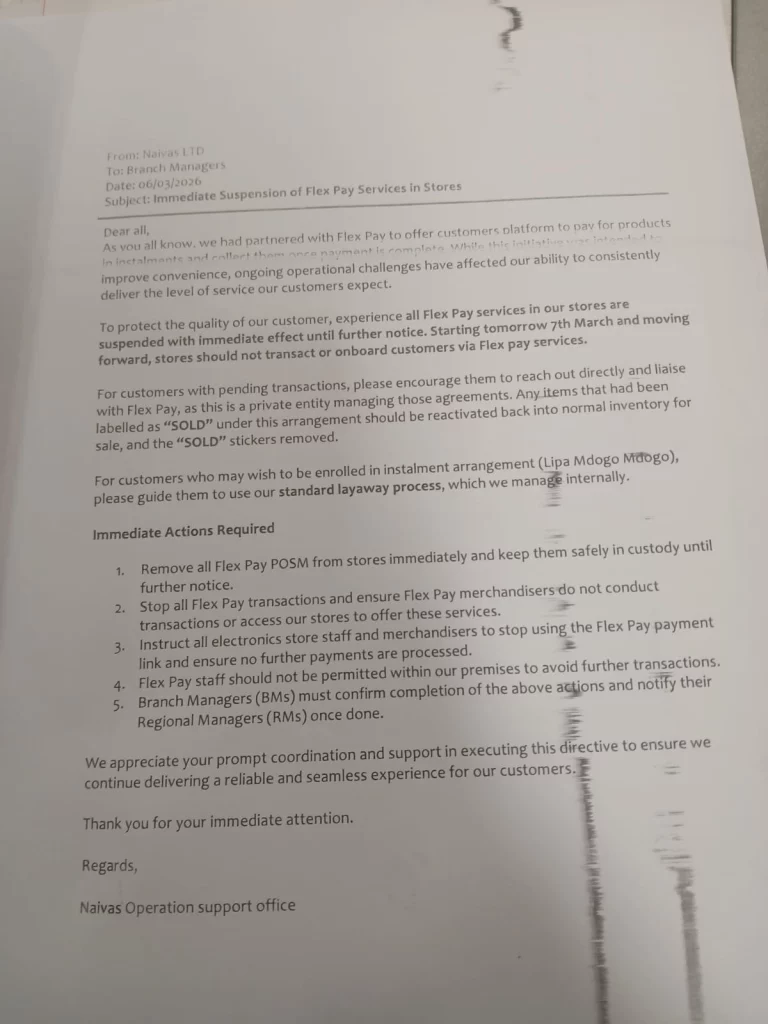
On March 6, 2026, managers at Naivas supermarkets, Kenya’s largest retail chain by branch count, received an internal memo from the retailer’s operations support office to stop doing business with FlexPay.
Beginning the next day, stores were to stop accepting transactions from the instalment-payment platform, which had operated inside Naivas branches for five years. Employees were told to stop onboarding customers, remove FlexPay promotional materials, and prevent its staff from operating inside Naivas stores.
Even goods that customers were already paying for were affected.
“Any items that have been labeled as ‘SOLD’ under this arrangement should be reactivated back into normal inventory for sale,” the internal memo reviewed by TechCabal said.
The internal memo called it an “immediate suspension” caused by “ongoing operational challenges.” Those three corporate words concealed a relationship that was coming apart.
For five years, FlexPay and Naivas had helped customers buy goods in instalments. FlexPay’s lawyers say the partnership processed more than KES 3 billion ($23.1 million) in transactions. A Naivas insider familiar with the arrangement, who asked not to be named because they were not authorised to speak publicly, confirmed the lawyers’ claims.
“The relationship subsisted for approximately five (5) years and was highly successful. Over that period, the platform processed customer transactions exceeding Kshs. 3 billion and drove substantial footfall to Naivas outlets countrywide,” FlexPay said in court filings.
According to the correspondence, the companies could not agree on who owed whom money.
Within days, lawyers were trading demands over roughly KES 30 million ($231,000). FlexPay questioned the accounts and alleged that its systems had uncovered more than KES 300 million ($2.3 million) in suspicious transactions involving Naivas employees. Then the police entered the dispute.
A Directorate of Criminal Investigation (DCI) official familiar with the matter told TechCabal that Naivas sought the agency’s help to pursue Martin Kariuki Maina and Johnson Gituma Mwangi, founders of FlexPay, over the disputed funds.
“This issue was reported in April, and it was high-stakes. Naivas wanted DCI to help recover the money from FlexPay,” the officer said.
Over the following months, the founders received repeated calls from police officers, some involving threats and demands for money, according to the officer.
The pressure continued until September 2, when police arrested them in Nairobi’s Roysambu area. The allegations of threats and demands for money could not be independently verified.
Naivas and the DCI did not immediately respond to TechCabal’s email requests for comment.
The Naivas-FlexPay dispute falls into a growing pattern in which Kenya’s criminal justice system is used to resolve commercial disputes.
In July, Citibank Kenya went to the High Court seeking to stop the DCI from investigating its chief executive, Martin Mugambi, over a disputed KES 261 million ($2 million) loan to the Kenya Tea Development Agency (KTDA)—a company owned by 600,000 smallholder farmers—for Kiru Tea Factory in Murang’a, a county 80km north of Nairobi.
Citibank argued that investigators were criminalising a commercial decision and using police powers as leverage in a civil dispute.
TechCabal reconstructed the breakdown of the Naivas-FlexPay relationship from contracts, internal communications, demand letters, police statements, correspondence with prosecutors, court documents, and interviews with a Naivas insider and DCI source.
While the records do not establish that no crime occurred, they show that before FlexPay executives were publicly accused of theft, the money at the centre of the investigation was already the subject of an unresolved commercial dispute.
Billions over five years
The partnership began in February 2021 when Naivas engaged Flexitech Group Limited, which trades as FlexPay, to run a digital platform that lets customers select goods and pay in instalments through the fintech.
Under the arrangement, once goods were collected, FlexPay was required to remit payment to Naivas by the close of the following day, less a 5% discount. Naivas employees involved in FlexPay sales also received a 1% incentive, according to FlexPay’s letter to the Office of the Director of Public Prosecutions (ODPP).
The contract was supposed to run for seven years, until February 2028. FlexPay’s lawyers say in their letter to the ODPP that the platform processed more than KES 3 billion over the relationship.
Then the arrangement became more complicated. In December 2023, the companies varied their agreement to accommodate loyalty points for FlexPay customers shopping at Naivas. FlexPay says it pre-funded those points and was supposed to be reimbursed by Naivas.
By March 2026, a FlexPay audit put the unreimbursed amount at over KES 24 million ($185,000). TechCabal has not independently audited the figures.
For another two years after the 2023 variation, the partnership continued. Then, toward the end of 2025, the supermarket chain wanted to change the terms.
FlexPay says Naivas wanted to reduce its commission from 5% to between 0.5% and 1% to cut costs. FlexPay countered with 3%. According to its representations to prosecutors, Naivas never accepted the proposal.
Around the same time, FlexPay says its systems began showing something strange.
A KES 10,000 ($77.11) purchase would appear as KES 100,000 ($771), then later disappear.
FlexPay alleged that some Naivas employees inflated the value of goods entered on its platform, then later reversed the transactions as “typographical errors.”
The extra zero meant Naivas employees would receive larger incentives, linked to sales through the platform. FlexPay’s lawyers said its audit eventually identified more than KES 300 million ($2.3 million) in transactions displaying the pattern.
TechCabal has not independently established that the transactions were deliberately manipulated.
FlexPay says it raised the transactions with Naivas and requested a joint investigation. It later lodged a complaint with the DCI’s Economic Crimes Unit on April 2, according to the DCI officer and a letter seen by TechCabal.
Naivas wanted its money
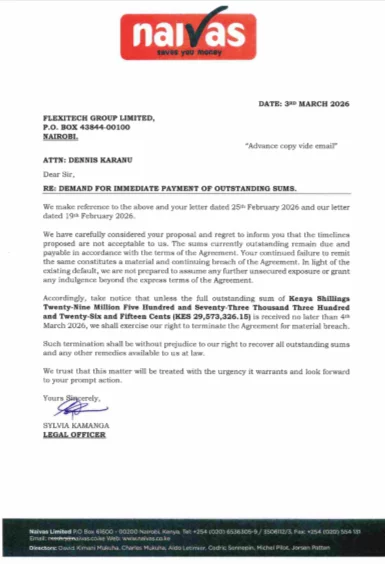
By March 3, Naivas wanted the platform to remit KES 29,573,326.15. The supermarket said the money was outstanding under their agreement and warned that it would terminate the contract unless the balance was cleared.
Six days later, the figure had grown. Bowmans, acting for Naivas, demanded KES 30,211,825.25 ($234,000). The lawyers calculated that FlexPay had generated KES 49.8 million ($386,000) in February sales but paid KES 26.3 million ($204,000), leaving KES 23.48 million ($182,000). Another KES 6.73 million ($52,000) was attributed to March.
FlexPay lawyers asked for ten days to respond and said the company wanted an amicable settlement. In an earlier correspondence, FlexPay had committed to regularising the outstanding amount and providing a bank guarantee.
By March 17, its lawyers were disputing the KES 30.2 million ($234,000), although they said the company was willing to settle if given time. They also claimed FlexPay had generated KES 940 million ($7.3 million) in sales for Naivas in 2025.
But before the lawyers could settle on the terms and how much was owed, Naivas had already pulled the plug.
The March 6 memo stopped FlexPay transactions from the following day. Yet the formal termination notice came on March 17, giving 30 days’ notice to April 16. By then, Naivas wanted KES 31,213,700.95 ($242,000).
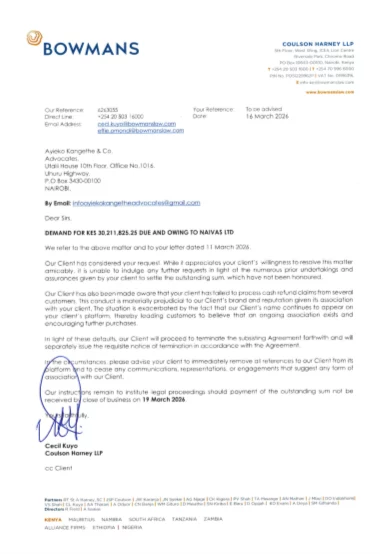
In two weeks, the amount demanded had increased from KES 29.6 million ($229,000) to KES 30.2 million ($234,000), then to KES 31.2 million ($242,000).
FlexPay’s argument also changed.
By March 31, FlexPay’s lawyers were saying the account could not be reduced to customer money collected but never remitted.
There were the loyalty points, which FlexPay said Naivas had not reimbursed. They also raised commissions, claims of staff-manipulated transactions, and payments already made.
While Naivas maintained that FlexPay had failed to remit funds to the supermarket as required under the contract, FlexPay maintained that the balance had to be reconciled against money it claimed Naivas owed it and transactions it disputed.
Their contract’s dispute-resolution clause called for negotiation and consultation, followed by mediation and, if necessary, arbitration. FlexPay executives asked to meet, but this never happened, and they never agreed on the final figure.
According to court filings and DCI complaints, FlexPay executives began receiving threats and summonses from police.
A commercial debt or suspected theft
When FlexPay finance executive Dennis Karanu Mwangi sat down with a DCI officer to record a statement on May 5, he was also questioned as a suspect.
A DCI statement says investigators were examining allegations of “stealing by an agent”. Mwangi was cautioned that he did not have to say anything and that anything he said could be used as evidence.
He told investigators about the commercial relationship that appears throughout the correspondence, including the five years with Naivas, the loyalty points, and the disputed accounts and transactions, which he believed Naivas employees had inflated.
The dispute was now running in two directions. Naivas had gone to investigators over money it said FlexPay had failed to remit. FlexPay, meanwhile, reported Naivas employees to the DCI over the suspicious transactions.
FlexPay had already begun asking prosecutors to intervene.
On March 31, its lawyers wrote to the ODPP under the subject “Misuse of the criminal justice system.” They alleged that police were being used to pressure the company into paying KES 30.2 million ($234,000) arising from a contractual dispute.
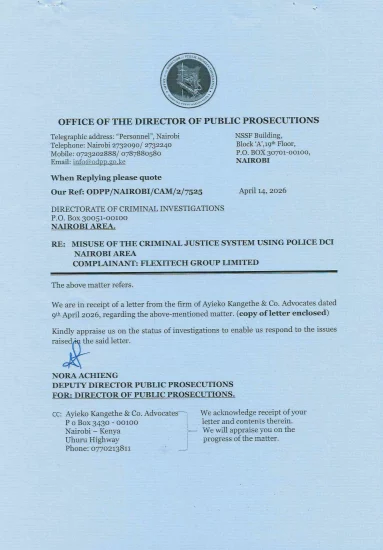
They wrote again on April 9. On April 14, the ODPP asked the DCI’s Nairobi Area office to provide an update on its investigation so prosecutors could respond to FlexPay’s complaint.
The ODPP’s intervention did not establish that police had been misused. However, it did show that prosecutors had been formally alerted to the dispute months before the arrests.
FlexPay continued responding to police summonses. Its lawyers say that on April 21, it supplied investigators with the contracts, loyalty-point audit, suspicious-transaction audit, and correspondence between the companies.
On May 5, FlexPay also transferred KES 3.07 million ($23,800) to Naivas by RTGS. Its lawyers later alleged that the supermarket neither acknowledged nor credited the payment. The investigation continued.
Five months of pressure
The DCI officer who spoke to TechCabal described the intervening months as a period of repeated pressure on FlexPay’s founders.
According to the officer, calls came unpredictably. Some involved demands that the company resolve the money claimed by Naivas, while others included threats and demands for bribes, the officer said.
TechCabal could not independently verify those allegations, and the DCI did not immediately respond to questions.
What is documented is that the investigation remained active for months.
Then, on September 1, DCI officers arrested Maina and Mwangi.
They spent the night at Kilimani Police Station before being released on police bond the following day. Their lawyers said both men had previously honoured police summonses. Images of the executives subsequently circulated online alongside allegations that they had stolen from a retailer.
The commercial dispute was now a public criminal case.
On September 9, FlexPay’s lawyers filed a 15-page document asking the DPP not to approve charges. They asked prosecutors to consider their complaint concerning Naivas’s employees.
The dispute is now before the courts. FlexPay has sued Naivas, the DCI, and the ODPP after months of arguing that a disagreement over the companies’ accounts should not have led to the arrest of its executives on September 2.
The court will now have to consider whether the matter was a commercial dispute that became a criminal case, or a crime buried inside the disputed accounts.
True scale demands moving beyond surface-level integrations to robust execution. We’ve filtered the noise out of Moonshot 2026, optimising the conference strictly for high-calibre connections between startup founders, global financial operators, enterprise leaders and individuals rewiring Africa’s technical frameworks. Get 20% off Early Bird tickets for a limited time.

from TechCabal https://ift.tt/8ADeTJ6
via IFTTT

I am the CEO of 9JAGISTLAND.My name is Adedeji Timothy and my co-owner is Oyekola Damilare.This blog is born out of our passion to educating to people in all aspect of internet life.We are enthusiastic about writing posts and articles online.
Write your views on this post and share it. ConversionConversion EmoticonEmoticon