


TGIF. 
Trade finance can take days. In Mauritius, it took less than an hour.
Mauritius Commercial Bank and Export Trading Group (ETG), a Mauritian agribusiness company, said they have completed Africa’s first electronic Bill of Exchange transaction under Mauritian law, replacing paper documents that would have travelled by courier with digital ones that moved in minutes. It’s a small transaction with a potentially big implication for how African businesses move money and goods across borders.
Reminder: We’re looking for stories from people whose journeys changed at Moonshot. Met a co-founder, investor, partner, or future employer there? Tell us about it.
Let’s get into today’s dispatch.
Read smart insights about Francophone Africa’s tech ecosystem—weekly.


Ecommerce
Pepco, a Polish retailer, wants to expand into Africa. Here’s why that’s interesting.

Pepco sells €3 ($5.44) T-shirts and cheap toys across Europe for a reason: scale. The Polish discount retailer has built a huge sourcing strategy around buying large volumes at low prices, mostly from China, India, and Bangladesh, then moving those goods into more than 4,000 stores across 18 European countries. Its global sourcing operation works with more than 375 vendors and 1,200 factories.
Now, that distribution setup is getting more expensive to run.
Why? Geopolitical tensions have disrupted shipping routes between Asia and Europe, forcing some vessels to take longer routes around Africa. Freight costs and delivery times have become less predictable. Pepco told Bloomberg that it was protected from some of the initial shock because it tends to source products with longer lead times, but it is still looking for ways to make the supply chain less dependent on one part of the world.
One option is Africa.
Why Africa? It is not simply because Africa has cheap labour. If that were enough, factories would have flooded the continent for years.
State of play: The real attraction is geography. North Africa sits close to Pepco’s biggest market, Europe. Tunisia, for example, already sends 73% of its exports to the European Union (EU), while textiles and machinery are among its biggest exports. Egypt also has a free-trade area with the EU, removing tariffs on industrial goods. That gives African manufacturers something Asia cannot: the ability to make products closer to the customer.
But Pepco also needs those products to remain cheap. Its entire business is built around offering families budget-friendly low prices, and its sourcing scale is a big part of how it does that.
This is where Africa has a lot to prove. China’s advantage is beyond labour costs; it has an enormous network of factories, suppliers, skilled workers, ports, and logistics companies that can work together at scale. On Monday, Reuters reported that some companies that moved production out of China to escape tariffs have struggled to reproduce that ecosystem elsewhere, with higher costs and operational problems pushing some orders back to Chinese suppliers.
So Pepco’s Africa plan is really a test of something bigger. Can an African production hub get close enough to Europe, and become efficient enough, to compete with an Asian manufacturing ecosystem that has spent decades getting very good at making cheap things?
Between the lines: Africa has some of the pieces. Its proximity to Europe is one. Existing textile and manufacturing clusters are another. But reliable electricity, ports, suppliers, trade agreements, customs, and the ability to produce consistently at Pepco’s scale will decide whether those advantages translate into cheaper goods.
Zoom out: Pepco has not yet named the African countries it is considering expanding into. If it moves production here, it would be interesting to see its play on the continent: beyond using Africa as a distribution and routing hub, could it compete for retail share-grab in the continent itself? Discount retailers like Pepkor (how ironic!) would be watching.


Every business owner needs to watch this.

The business questions you Google, answered by experts. Watch for free .
Funding
The US is backing data centre operator WIOCC with $155 million to build Africa’s digital backbone

The West Indian Ocean Cable Company (WIOCC) Group, an Africa-focused data centre operator, is set to receive up to $155 million from the US International Development Finance Corporation (DFC), the American government’s development finance arm. It is the DFC’s largest-ever equity investment; it will help WIOCC expand its digital infrastructure across the continent.
Explain like I’m new here: WIOCC operates fibre networks, subsea cables and data centres across more than 30 African countries, including Nigeria, South Africa, Kenya, and the Democratic Republic of Congo (DRC). WIOCC has been on a serious fundraising run. On September 1, the company announced a $300 million investment from Africa Finance Corporation (AFC), a pan-African development finance institution (DFI), and Saudi investment company Vision Invest. In 2021, it raised $200 million in mixed debt and equity funding, and raised over $400 million across three separate rounds in 2025.
Why is the United States interested? The country wants its technology companies to have room to grow in Africa, and they need infrastructure to do it, especially as American technology companies expand their cloud and AI businesses across the continent. In 2024, Microsoft and G42 announced a $1 billion digital ecosystem investment in Kenya, including a data centre that will run Microsoft Azure, as well as connectivity and cloud infrastructure.
The DFC has also invested $50 million in pan-African infrastructure company Cassava Technologies in 2022, highlighting its role in helping American hyperscalers expand across the continent. Now Washington is backing WIOCC.
Why should you care? Everything you do online eventually needs somewhere to go, including your WhatsApp message, bank transfer, Netflix stream, or AI prompt. The more businesses use cloud and AI services, the more infrastructure Africa needs. The US isn’t just throwing money at another tech company. It is investing in the roads underneath Africa’s digital highway and hoping American companies get to drive on them.
Don’t miss Moonshot 2026 for anything in the world!

True scale demands moving beyond surface-level integrations to robust execution. We’ve filtered the noise out of Moonshot 2026, optimising the conference strictly for high-calibre connections between startup founders, global financial operators, enterprise leaders and individuals rewiring Africa’s technical frameworks. Join us on October 28 & 29, 2026. Get your ticket .
Capital Markets
Regional stock exchange BRVM has suspended three Ivorian companies
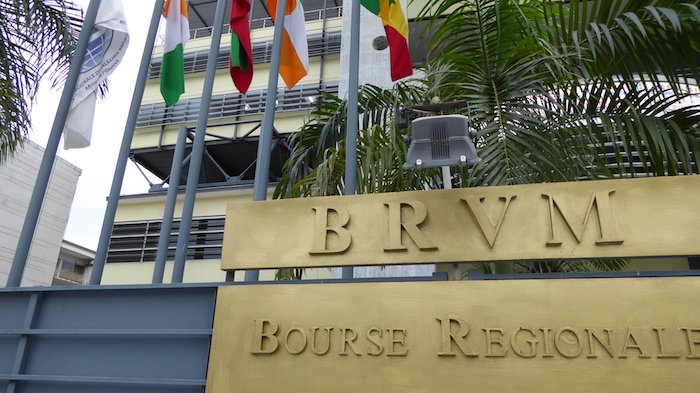
The Bourse Régionale des Valeurs Mobilières (BRVM), Francophone West Africa’s regional stock exchange, has suspended trading in three Ivorian companies: sugar producer Sucrivoire, metal-packaging maker SONOCO Metal Packaging, and coconut-products company SICOR.
What did the companies do? SONOCO and SICOR failed to publish required financial information, including their H1 2026 results. Sucrivoire had not published information that could materially affect its share price. Trading has been halted since Wednesday; the companies will remain suspended until they fix the issues.
Explain like I’m new here: The BRVM is the stock exchange shared by eight West African countries: Benin, Burkina Faso, Côte d’Ivoire, Guinea-Bissau, Mali, Niger, Senegal and Togo. It currently has 47 listed companies and about CFA21.13 trillion ($37 billion) in equity market capitalisation as of Thursday evening.
So how big are these companies and why does this matter? Not huge by BRVM standards. Sucrivoire is worth about CFA60.47 billion ($105.8 million), SONOCO about CFA37.65 billion ($65.9 million), and SICOR about CFA5.04 billion ($8.8 million). Together, they represent roughly 0.5% of the exchange’s equity value.
But size is not the point. When investors buy shares, they need regular, updated information to decide what those shares are worth. If results are missing, or important news is held back, investors could risk trading with an incomplete picture.
Between the lines: BRVM had to step in to freeze trading because letting investors buy or sell while material information was missing could leave some participants making decisions with an incomplete picture of the companies.
Zoom out: There is also a warning here for listed businesses. Going public gives companies access to capital and investors, but it also comes with a price: you have to keep the market informed. In 2025, SONOCO faced a suspension for delayed financial results.
Insights
Funding Tracker
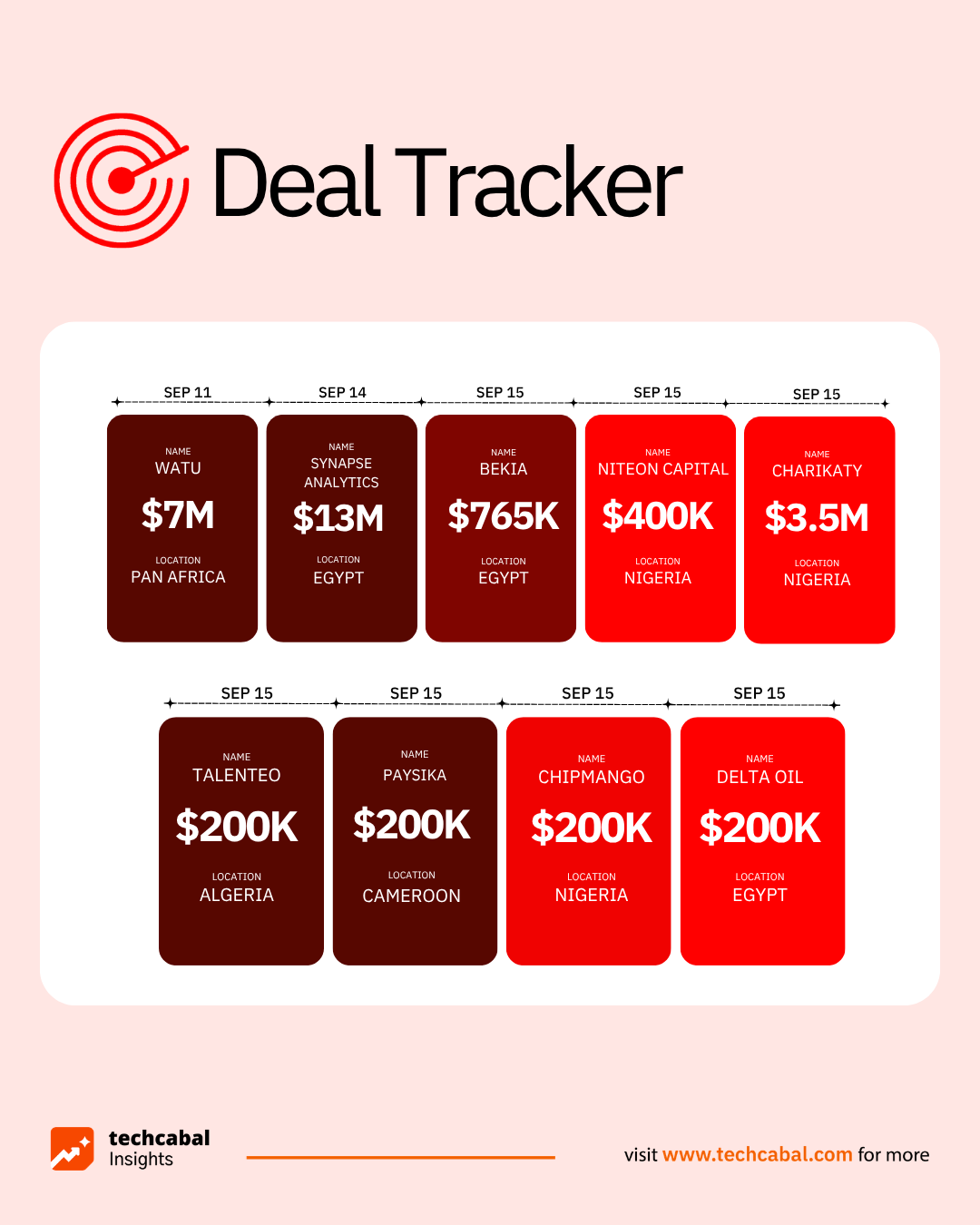
Synapse Analytics, an Egyptian-based AI infrastructure company, raised $13 million in a Series A funding round led by Partech, with follow-on participation from Algebra Ventures and Silicon Badia. (Sep 14)
Here are the other deals for the week:
- Watu, a Pan-African fintech startup, secured a $7 million debt facility from AHL Venture Partners. (Sep 11)
- Niteon Capital, a Nigerian fintech startup, secured a $400,000 grand prize from the UN Sustainable Enterprise Accelerator Fund. (Sep 15)
- Charikaty, a Moroccan legaltech startup, secured $3.5 million in pre-seed funding from Dubai-based Red Tape Ventures, Mastercard Kuwait executive Faris Al-Obaid, Saudi footballer Faris Abdi, and other undisclosed investors. (Sep 15)
- Talenteo, an Algerian HR software startup, secured $200,000 in funding from Madica. (Sep 15)
- Paysika, a Cameroonian fintech startup, secured $200,000 in funding from Madica. (Sep 15)
- ChipMango, a Nigerian DeepTech startup, secured $200,000 in funding from Madica. (Sep 15)
- Delta Oil, an Egyptian cleantech startup, secured $200,000 in funding from Madica. (Sep 15)
- Bekia, an Egyptian cleantech startup, raised $765,000 in a seed funding round led by Madica, with participation from Catalyst Fund and Jambaar Capital. (Sep 15)
- Biochar Industrial Group (BIG), a Nigerian climate-tech startup, raised $1.5 million in pre-seed funding, led by BREEGA with participation from the Catalyst Fund. (Sep 17)
That’s all for this week. Before you go, did you know that African Startups raised $2.10 billion in 8 months?. Find out how it happened here!
Follow us on Twitter, Instagram, and LinkedIn for more funding announcements.
CRYPTO TRACKER
The World Wide Web3
Source:
|
Coin Name |
Current Value |
Day |
Month |
|---|---|---|---|
 Bitcoin Bitcoin |
$77,551 |
+ 1.64% |
+ 20.68% |
| Ether |
$2,483 |
+ 1.93% |
+ 30.01% |
| Chump Coin |
$0.02433 |
– 9.58% |
+ 643.88% |
| Solana |
$105.65 |
+ 6.02% |
+ 37.34% |
* Data as of 06.43 AM WAT, September 18, 2026.
Opportunities
- The Citi Foundation is offering $500,000 grants to 50 organisations that help low-income young people build AI and other job skills. The grants can support programmes that teach skills such as prompt engineering and digital content creation, help young people find jobs, provide access to devices and software, or add AI tools to existing employment programmes. Applications close on October 6, 2026, at 5 p.m. Lagos time. Apply here.

- Nigeria’s data localisation deadline is testing its financial infrastructure
- Before AI saves the world, can it help fix everyday life?
- South Africa joins the global resistance against American data centers
- Inside the suddenly explosive world of AI safety
- Kenya’s Central Bank says Middle East crisis frustrates push for cheaper loans
Written by: Emmanuel Nwosu, Yemi Kareem, and Success Sotonwa
Edited by: Emmanuel Nwosu & Ganiu Oloruntade
Want more of TechCabal?
Sign up for our insightful newsletters on the business and economy of tech in Africa.
- The Next Wave: futuristic analysis of the business of tech in Africa.
- Francophone Weekly by TechCabal: insider insights and analysis of Francophone’s tech ecosystem
P:S If you’re often missing TC Daily in your inbox, check your Promotions folder and move any edition of TC Daily from “Promotions” to your “Main” or “Primary” folder and TC Daily will always come to you.

from TechCabal https://ift.tt/d29zRei
via IFTTT

I am the CEO of 9JAGISTLAND.My name is Adedeji Timothy and my co-owner is Oyekola Damilare.This blog is born out of our passion to educating to people in all aspect of internet life.We are enthusiastic about writing posts and articles online.
« Prev Post
Next Post »
Write your views on this post and share it. ConversionConversion EmoticonEmoticon