

Last Friday afternoon—one of those deceptively calm ones that sit lightly over the chaos of a Lagos day—Bernard Chiira appeared on my screen from Nairobi. He sounded relaxed, almost unguarded, speaking with the ease of someone who has told parts of this story before, but not quite like this.
Chiira was born in central Kenya with brittle bone disease, a condition that meant fractures, surgeries, and long hospital visits from as early as two weeks old. But his story, like many that seem defined by limitation, bends instead toward possibility.
When we speak, it feels like reliving parts of his struggles. As someone who has a disability, I find parts of his journey familiar: the negotiations with systems not designed for you, the improvisations, the small wins that can go unnoticed. He laughs easily, even when recalling being expelled from nursery school after just a month because his condition was considered too delicate.
Things began to shift at Joytown, a special boarding school where independence was taught as a skill. He would later insist on moving into mainstream education, studying computer science, and eventually working in innovation, long before disability became central to his work.
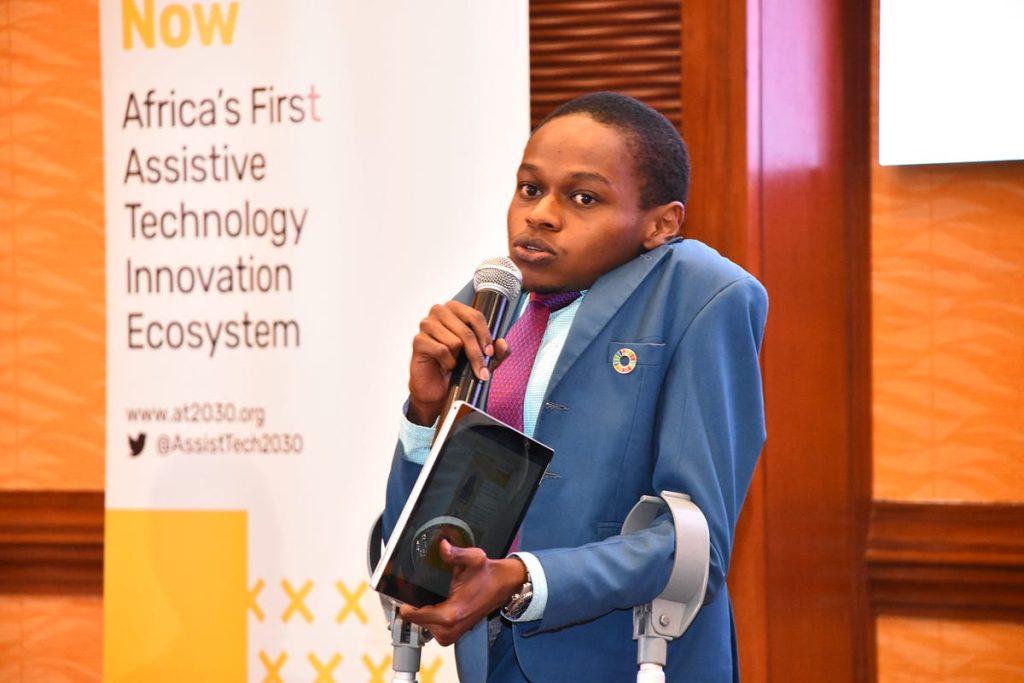
Today, he is the co-founder of Innovate Now and leads the Assistive Tech for Disability Trust, building one of Africa’s first ecosystems for assistive technology. He believes people with disabilities should not just use technology, they should build it.
The challenges, he says, are structural—limited capital, weak policy alignment, and products that often miss users’ realities. But he sees this as a long game. Like M-PESA once did for fintech, he believes assistive tech will find its moment.
“Even five million people accessing the right assistive technology,” he says, “would mean everything.”
In his spare time, he plays chess, spends time with his family, and speaks wherever he can. The mission, he insists, is bigger than him.
This interview has been edited for length and clarity.
Before Innovate Now, what was life as a person with disability like?
I was born in central Kenya with brittle bone disease, which caused repeated fractures in my right leg from two weeks old until I was about 19 or 20. I had many surgeries.
Inclusion started at home. My parents accepted all their children equally, even though some had disabilities and some didn’t. My mother gave up her career to care for four kids with disabilities, and my father was the sole provider.
When I started nursery school, the doctors said I had great potential. But after a month, the school expelled me because my condition was too delicate. So I went to a special boarding school called Joytown. There, because everyone had disabilities, they trained us for life independence, music, and public speaking. One year, I ranked first in the country in public speaking, a skill I now use every day as a CEO.
After nine years, I refused to go to another special school. I wanted to adjust to the real world. My parents found a regular high school with the right attitude, even if it wasn’t physically accessible.
I studied computer science, worked in a university innovation lab, and became an incubation manager supporting tech startups from 2012 to 2019. At university, I met my wife in the choir. We now have four children.
Everything was a struggle—education, work. But people in Africa generally accept people with disabilities. The failure has come from systems and leaders who don’t prioritise our needs.
Was there a time when the absence of assistive technology made things difficult for you to do?
Yes. Because of my physical disability, I’ve used different types of assistive tech. For mobility, I primarily use crutches; I’ve been using them since kindergarten. I can dance with crutches, something most people don’t think is possible.
The challenges came from getting the wrong devices. Early crutches were metal and heavy. When you fall while using underarm crutches, you’re trapped because they support your entire body. I switched to lighter aluminium elbow crutches, which worked well.
At one point, a local workshop made a prosthesis for my shorter leg. It was so heavy that when sitting, I had to keep my legs straight. It didn’t work. I also wore a raised shoe with a big platform to compensate for the nine-inch difference. It became dangerous; I twisted and got another fracture.
I also developed scoliosis around age 11 or 12. They gave me a brace—an upper-body orthosis. But because I was in boarding school and it needed frequent adjustment as I grew, a strap damaged my clavicle bone. I abandoned that, too.
What happens when people don’t get the right assistive tech? They abandon it, or it causes more harm than good. When people lack information, access to repair services, or have no choice, it impacts their quality of life. I experienced all this as a child.
Was that what led you to come up with this idea of persons with disabilities building alongside developers of assistive technology?
Actually, no. I never in my wildest dreams thought I would work at the intersection of disability and innovation. I left Strathmore in 2019. As an incubation manager, I had an external-facing role. One day, professors from University College London’s Global Disability Innovation Hub visited. They were researchers in disability innovation. Never before had I discussed disability and innovation in the same context—they were two separate worlds.
They received funding from the UK government following the 2018 Global Disability Summit, a joint initiative between Kenya and the UK. They wanted to launch a programme in Kenya because we were already known for innovation, like mobile money. They believed assistive products don’t exist partly because there’s no local industry.
They asked if I would help develop the project. I felt a personal connection. I left my permanent job to launch Innovate Now in Africa as co-founding director.
We started at Amref Health Africa. I was a one-person team. We crafted everything from scratch—the curriculum, the networks, and the model that requires persons with disabilities to be involved from the beginning.
Innovate Now was initially funded by the United Kingdom Aid (UK Aid) and led by GDI Hub. We went from Cohort 1 in 2019 to Cohort 11 now. But in between, a few changes happened. COVID hit us like everybody else. Funding cuts came. Using my networks from my previous job, I fundraised from the Norwegian Agency for Development Cooperation (NORAD). And that is how we entered a new phase of the programme in 2022, where we started focusing on digital assistive tech, extending support beyond Kenya across the continent.
In 2023, we spun out and created Assistive Tech for Disability Trust (AT4D). We’re now an innovation hub and accelerator, but also more than that. We launched the Momentous Fund Pilot for early-stage startups. We published the first scoping study on AI and disability across Ghana, Kenya, and Rwanda that talked to people with disabilities and other stakeholders about how AI can benefit people with disabilities. And out of that, we are creating a hub for AI and disability. We’re working on humanitarian innovation with a project called NIKO—No One Is Kept Out—helping humanitarian actors reach children with disabilities in hard-to-reach areas.
My lived experience with disability and my professional expertise came together. This work has succeeded because of my team and partners—not by chance, not a solo success.
Was there a time you doubted if this could work?
I have never doubted that this can work. There have been very challenging moments with uncertainty. Even today, there are unanswered questions about market potential, purchasing power, and the industry is skewed toward the West. But these challenges are fuel.
I envision Africa emerging as a continent where people with disabilities are included everywhere—in society, in markets, in capital systems.
I was in Sydney, Australia, talking to an elderly person, and I asked how Australia achieved disability inclusion. He said, “You might think we’ve always been inclusive, but all this progress has happened only in the last 50 to 60 years. Even developed economies still face the same challenges. But if people persist and keep pushing, things eventually work.”
It’s a long-term game. There will be short-term gains, but if we want to see the whole of Africa inclusive and accessible, then it won’t happen tomorrow. Slowly by slowly. Some things can happen fast with just goodwill and a change in mindset.
Why does it look like African investors do not invest in Assistive Technology?
Investors operate on predictability. Even when investing in high-failure startups, they need references and data showing sustainability and returns.
Look at fintech. Nobody advocates for investors to believe that fintech in Africa is viable anymore, because enough time has passed since M-PESA in 2007 to demonstrate its viability. Go back to 2007, very few would have believed.
That’s our challenge with new emerging areas. Not just assistive tech, green renewable energy still doesn’t have enough successful cases.
Investors will change their minds when they see trends, data, and success cases. 10 or 15 years ago, we didn’t even have visibility for assistive tech startups. Now we have an ecosystem across Africa. It’s no longer whether people can build assistive tech; it’s how we enable these startups to succeed and demonstrate investment readiness.
In the next few years, you will start seeing very successful assistive tech companies from Africa. It’s already happening elsewhere; AT companies have exited, done IPOs. Just not yet here. We need patience, ecosystem building, and early-stage support. The pilot fund is building this case.
How much role does the government need to play in all of this?
The government has a critical role. Governments that make early moves will see significant transformation. Across Africa today, disability is a social protection issue discussed only in Ministries of Health and Education. Kenya has had disability law since 2003, updated in 2025, strong on social protection.
What’s missing is governments not understanding the economic case, not yet willing to connect the dots with ministries that allocate capital to innovation and infrastructure.
We need finance ministers and presidents to understand the economic case: job creation, investing in accessible infrastructure, manufacturing assistive technology, and including assistive tech in startup agendas.
When you build a new road, economic activity becomes vibrant. Same concept: enable people with disabilities to move affordably and accessibly. That alone has a massive economic impact. When people move, capital moves, ideas move. They have access to education and healthcare.
The future is everyone participating. Countries like Qatar, since hosting the World Cup, have upgraded their infrastructure to make it more accessible. It’s possible. It needs belief, political will, and resources.
What did you misunderstand about building for persons with disabilities and innovation that you understand now?
I came from the high-paced startup world: speed and agility. Early on, I learned that innovation embedded in another organisation sometimes can’t have that startup culture. Bureaucracy and innovation don’t go hand in hand.
But you also find clear examples of disability moving humanity forward. Technologies we all use today—audiobooks, electric toothbrushes, keyboards, captions—were initially designed as assistive tech. Captions were designed for deaf people. Inclusive design creates a superior user experience for everyone.
Assistive tech markets are likely larger than just people with disabilities.
I also didn’t know how the transition from project to institution would happen—the funding gaps, having only six months to figure out if this would work. Collaboration can be difficult because incentives must align.
But my North Star is knowing, without a doubt, that this is the shift that needs to happen. We’re already seeing results. HopeTech, from Cohort 1, a Kenyan company building wearable tech for blind people, is now in the UK and Europe. Assistive tech entrepreneurs can go to other markets and compete because disability is universal.
How hard can it be, though?
It is very hard. The odds are against assistive tech entrepreneurs. Your target consumers are often economically disenfranchised, with low purchasing power, which forces you to adopt innovative business models. Raising capital is very difficult. Regulations can be stringent because these products protect people’s lives. And African markets are segmented; scaling across countries is difficult due to different regulations.
But these are the challenges that make innovation important.
Do you still face discrimination despite all this?
Yes. I’ve had interactions where I felt stigmatised; people confusing me for someone begging for money, then seeing me walk to my car and drive off. I don’t blame them entirely. It’s the frame society has created.
Discrimination happens on digital platforms, too. Once, when I said I had a disability, my visa process was treated as if I had an infectious disease. It was very difficult to travel.
It still exists. I challenge it in a way that allows people to understand.
When things get tough, how do you chill out?
Having a family and people who support you is really important. I have a mantra: zoom out and see the big picture. My wife supports me a lot. I have mentors.
I play a lot of chess. I love socialising and spending time with people outside the workplace. I do volunteer speaking work.
At the end of it all, God’s grace and my faith give me strength. There’s a bigger purpose. It’s not about me. That energises me, even when daily challenges discourage.
If we have this conversation again 10 years from now, what would you say must have happened for you to say this went great?
Ten years from now is 2036. I hope it will be clear that this was the right approach: advocating for capital allocation for innovation, governments taking assistive tech seriously, and AT4D contributing significantly to people with disabilities accessing the assistive tech they need.
If by then we can say even five million people have better lives because of our work, I’ll be happy. By 2050, we aim to enable 10 million people to access assistive tech on our website.
Funding assistive tech startups will be the norm. Companies will succeed easily. Disability inclusion will no longer be where it is now in how people think about it; it will be something people embrace.
That’s my vision for the future.
from TechCabal https://ift.tt/SxrGQPU
via IFTTT

I am the CEO of 9JAGISTLAND.My name is Adedeji Timothy and my co-owner is Oyekola Damilare.This blog is born out of our passion to educating to people in all aspect of internet life.We are enthusiastic about writing posts and articles online.
Write your views on this post and share it. ConversionConversion EmoticonEmoticon