

Somewhere in Nigeria, a finance team in a company spends weeks, or even months, manually reconciling paper receipts and hunting through email chains for PDF attachments. Hundreds of Nigerian businesses face this reality, with ₦3.4 trillion ($2.5 billion) in recoverable Value Added Tax (VAT) returns locked in the economy.
Under the 2025 tax reforms, a paper receipt or a standard PDF is no longer enough to prove a transaction; if an invoice isn’t pre-cleared by the Nigeria Revenue Service (NRS) before it reaches a client, it transforms from a claimable asset into a financial liability.
The Nigerian government, through the NRS, introduced a mandatory e-invoicing framework. E-invoicing, under the new tax rules. With medium-sized businesses having until July 2026 to comply with the new mandatory framework, there is no better time to audit your processes.
In this piece, we break down the best e-invoicing insights into clear categories for easy action, and spoke to Olumide Akinsola, Country Director, Nigeria, at Namiri Technology (DigiTax), a platform that enables businesses and individuals to manage their e-invoicing requirements.
What is e-invoicing?
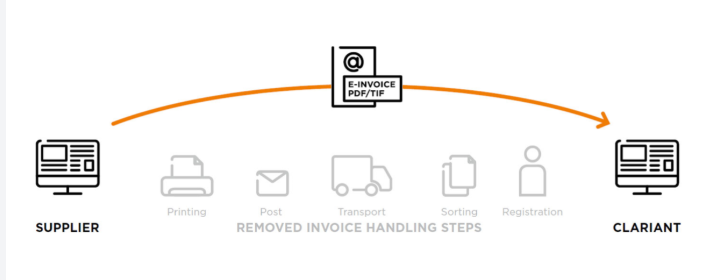
E-invoicing is the electronic exchange of a clearance document between a supplier, the tax authority, and a buyer.
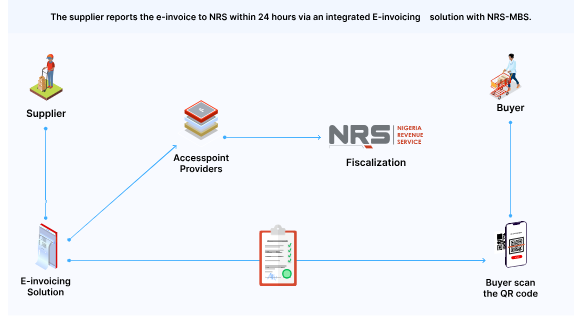
In Nigeria, this system operates under the framework of the Nigeria Revenue Service (NRS), through the Merchant Buyer Solution (MBS), Nigeria’s national E-invoicing framework. The national platform is designed to enable businesses to generate, validate, and exchange invoices electronically in real time.
“This is not a reporting obligation you discharge once a year; it is a live, transaction-by-transaction compliance system covering business-to-business, business-to-government, and business-to-consumer transactions,” Akinsola noted.
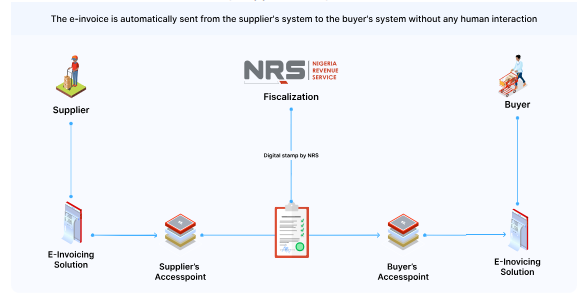
“For decades, businesses have been handing each other paper receipts or emailing PDFs of invoices, and the tax authority only finds out about those transactions much later, if at all. E-invoicing replaces that with a system where every invoice is transmitted to a government-approved platform in real time,” Akinsola said.
For business-to-business (B2B) and business-to-government (B2G) transactions, the e-invoicing process is rigorous. Every invoice must be pre-cleared by the NRS before the buyer even receives it.
The cleared invoice, usually featuring a QR code, is then returned to the supplier to be delivered to the customer.
“That IRN-bearing invoice is the only legally recognised document for the transaction,” Akinsola shared.
Every invoice must be routed through an NRS-certified System Integrator or Access Point Provider, which is responsible for validating and transmitting invoices. Once validated by an Access Point Provider, such as DigiTax, the invoice is assigned two critical digital markers:
- Invoice Reference Number (IRN): a unique identifier assigned to each invoice, used to track and validate the invoice in electronic invoicing systems. It ensures the authenticity and traceability of the invoice throughout the invoicing process.
- Cryptographic Stamp Identifier (CSID): A unique digital signature applied to e-invoices. It ensures that each invoice is authentic, has not been tampered with, and complies with FIRS regulations.
Why the Nigerian government is mandating the e-invoicing transition
The primary motivation for the Nigerian government is revenue mobilisation.
For years, Nigeria has grappled with a persistent budget deficit, exacerbated by a porous manual tax system. The government is attempting to widen the tax net without necessarily raising tax rates for those already compliant, by mandating a digital trail for every commercial transaction. As a result, every Naira of Value Added Tax (VAT) collected at the point of sale would reach the federation account.
“Nigeria’s tax-to-GDP ratio stands at approximately 8.2%; one of the lowest in Africa and among the lowest in the world, against an African average of 16.1% and a broader emerging economy average closer to 15 to 20%,” Akinsola explained.
The government’s goal is to raise the GDP ratio to 18%, and e-invoicing is one of the tools to achieve it.
“A significant portion of taxable commercial activity currently goes unrecorded, under-reported, or deliberately obscured. E-invoicing is the government’s mechanism for making the real economy visible in real time, at scale, without the need for an army of auditors,” Akinsola stated.
By closing gaps created by invoice manipulation and Value Added Tax (VAT) under-declaration, the NRS can ensure that the real economy is visible as it moves.
There is also international pressure at play. To demonstrate fiscal responsibility to creditors like the International Monetary Fund (IMF) and World Bank, Nigeria has aligned itself with global standards.
In September 2025, Nigeria was registered as a Pan-European Public Procurement On-Line (PEPPOL) Authority, meaning Nigeria now uses the same e-invoicing standards as the UAE, Singapore, and Australia.
Akinsola said this “signals institutional seriousness in a way that policy announcements alone cannot.”
Akinsola added that by seeing who buys from whom and at what volumes, the NRS gains data that is invaluable for economic planning and financial inclusion initiatives.
“That data infrastructure has profound value for economic planning, tax policy, and financial inclusion initiatives,” Akinsola noted.
The rollout schedule
The mandate for e-invoicing is being rolled out in waves, starting with those who have the highest impact on the economy.
Phase 1, which went live on August 1, 2025, targets large taxpayers with an annual turnover of ₦5 billion ($3,678,500) or above. This group includes approximately 5,000 companies. While the initial deadline was August, it was extended to November 1, 2025, to allow for technical integration.
“The government cannot tax what it cannot see. Large businesses move enormous volumes of revenue; they are the highest-yield targets for compliance enforcement,” Akinsola explains.
The timeline for other businesses is as follows:
- Medium taxpayers—₦1 billion to ₦5 billion ($735,700-$3,678,500) turnover: Go-live in July 2026, with enforcement from January 2027.
- Small businesses—below ₦1 billion ($735,700) turnover: Rollout in 2027, with enforcement from 2028.
Akinsola compared the phased rollout to traffic safety laws, stating that “the logic mirrors how seatbelt laws were first enforced on highways before extending to all road users; you start where the risk and the capacity are highest.”
What are the penalties for non-compliance?
Businesses cannot afford to ignore these deadlines. The Nigeria Tax Administration Act 2025 has introduced heavy financial consequences that came into full legal force on January 1, 2026.
Under Section 104, if a business fails to process a taxable invoice through the MBS platform, they face a penalty of:
- ₦200,000 ($147.14) per invoice.
- Additionally, they must pay 100% of the VAT due on that invoice, plus interest at 2% above the CBN Monetary Policy Rate.
However, the damage goes beyond direct fines. Because an invoice without an IRN is not legally recognised, buyers cannot use it to claim input VAT credit. This creates a massive ripple effect in the supply chain.
“Invoices not routed through the MBS platform do not receive an IRN and are not recognised as valid tax documents; meaning buyers cannot claim input VAT credit on them, and sellers face potential disallowance of business expenses,” Akinsola warned.
How businesses can connect to the MBS platform
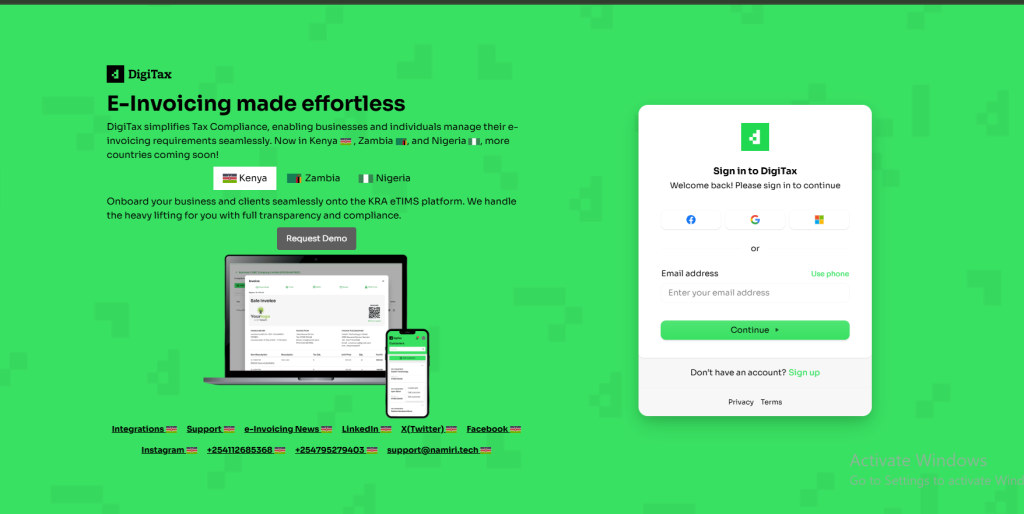
To comply with the law, businesses must route their invoices through NRS-certified providers like DigiTax Nigeria. There are two primary ways to get onboarded, depending on the company’s size and technical infrastructure.
- ERP integration
The first route is full Enterprise Resource Planning (ERP) integration. This is designed for large enterprises using systems like SAP, Oracle, or Microsoft Dynamics. By connecting the ERP’s invoicing module directly to the DigiTax API, the process becomes automated.
Akinsola described this as the “optimal route for large businesses processing hundreds or thousands of invoices monthly; it is seamless, scalable, and eliminates human error.”
- NRS-certified provider
The second route is through an NRS-certified provider, such as Pillarcraft, Heirs Technologies, or on the DigiTax web portal. This is a solution for businesses that are not yet ready for deep API integration. It allows them to raise, submit, and track invoices manually through a secure website, ensuring compliance from day one while the business plans for a more permanent technical setup.
The business does not have to deal with the NRS directly.
More details on onboarding a business for E-invoicing are available in the NRS user guide. To register, businesses need their Taxpayer Identification Number (TIN).
The benefits of e-invoicing for businesses
- VAT credits
E-invoicing solves a major financial headache for Nigerian companies: locked-up VAT credits. Under the Nigerian tax system, businesses can reclaim the VAT they pay on purchases (input VAT) against what they collect on sales.
However, the NRS will now only honour these claims if they are backed by an IRN-bearing invoice.
“The NRS will only honour input VAT claims backed by valid, IRN-bearing, MBS-compliant invoices. This is now codified in law; invoices not routed through the MBS platform are deemed invalid for tax purposes, and the buyer loses the right to claim input VAT on them entirely,” Akinsola pointed out.
Nigerian businesses stand to recover as much as ₦3.4 trillion ($2.5 billion) in input VAT credits locked away precisely because of non-compliant invoicing. For a manufacturer spending billions on raw materials, this is a massive amount of cash that can finally be recovered.
This creates a new dynamic where businesses must police their own suppliers.
“Your input VAT recovery depends directly on your supplier’s compliance status. A supplier who has not onboarded onto MBS is not just their own problem; they are a cash flow liability to every business that buys from them,” he said.
- Enhancing audit defence and operational efficiency
In the past, a tax audit was a stressful, backwards-looking investigation where accountants had to reconstruct months or years of records. E-invoicing changes this entirely. Since the NRS already holds the secured transaction record, an audit becomes a simple reconciliation exercise.
“The compliance risk that keeps CFOs and finance directors awake at night is substantially reduced,” Akinsola said.
Also, automation saves money. Once the system is integrated, the need for large manual compliance teams diminishes. Savings are found not just in the software, but in the reduced operational expenses required to prepare for audits and respond to government queries.
“Because the MBS platform holds a complete, cryptographically-secured record of every transaction in real time, audit preparation becomes a near-automated exercise rather than a weeks-long mobilisation of staff,” Akinsola noted.
- Improved access to credit and market credibility
An exciting medium-term benefit of e-invoicing is its impact on the credit market. Because every invoice on the MBS platform is verified and tamper-proof, banks can trust this data.
“Banks and fintechs will, over time, be able to use verified invoice histories as a basis for working capital lending and invoice discounting,” Akinsola explained.
This is particularly helpful for mid-sized businesses that often struggle to prove their turnover to formal lenders.
E-invoicing is becoming a prerequisite for doing business with big players. Multinationals and government agencies are increasingly making MBS compliance a condition for procurement.
“Being fully onboarded onto the NRS MBS platform is becoming a condition of doing business with the most commercially attractive counterparties in the Nigerian market; not just a regulatory checkbox,” he noted.
*Rate used is $1 to ₦1,359.25
from TechCabal https://ift.tt/QlH3aEY
via IFTTT

I am the CEO of 9JAGISTLAND.My name is Adedeji Timothy and my co-owner is Oyekola Damilare.This blog is born out of our passion to educating to people in all aspect of internet life.We are enthusiastic about writing posts and articles online.
Write your views on this post and share it. ConversionConversion EmoticonEmoticon